
How to improve quality for IXPE foaming master sheet - Sharing over ten years of experience from several senior process engineers at Ningbo Qinding
Normally, the surface of the IXPE master sheets obtained from the IXPE extruder should be smooth. However, in over water-cooled IXPE master sheets, sometimes longitudinal lines resembling ripples (usually parallel to the traction direction) appear on the surface or inside the IXPE master sheets. This phenomenon is called "water ripples" in the industry. Water ripples visually affect the appearance and lower the grade of IXPE foam products; performance-wise, they indicate uneven thickness of the IXPE foam sheet and localized degradation of physical properties (such as tensile strength and barrier properties). In short, water ripples have a significant impact on the quality of IXPE foam products. This article, drawing on over ten years of experience from several senior process engineers at Qin Ding Company, will provide a brief analysis of the causes of water ripples on IXPE master sheets and how to handle them, hoping to help our customers.
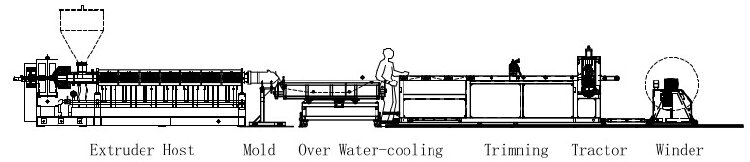

1. Cause Analysis
(1) Unstable melt pressure in the IXPE foaming extruder leads to uneven plasticization of the IXPE mixture within the extruder. The unstable melt pressure of the IXPE material mainly stems from the following aspects:
A. Screw wear (especially in the compression and metering sections), improper screw design (inappropriate compression ratio), or unstable screw speed can lead to uneven melt mixing of the IXPE mixture within the IXPE extruder, resulting in significant viscosity differences.
B. Feed interference: Poor hopper discharge (bridging, agglomeration), screw fluctuations, excessively high recycled material ratios, or large differences in particle size/density, etc., can cause instability in the feeding of the IXPE mixture into the IXPE foaming extruder.
C. Temperature "Roller Coaster": Failure of the heating coil, poor accuracy of the temperature control system, or improper thermocouple placement can cause drastic temperature fluctuations in the barrel or T-die of the IXPE foaming extruder, leading to changes in melt viscosity and unstable melt pressure.
D. Unstable Back Pressure: The IXPE foaming extruder is equipped with a filter. Severe filter clogging and failure to replace it in a timely manner can cause fluctuating melt pressure.
(2) Uneven flow within the dedicated T-die of the IXPE foaming extruder causes "water ripples": Improper die lip clearance adjustment (locally too wide or too narrow), die lip damage, and blockage by degraded carbon deposits or impurities inside the die cavity disrupt the uniform distribution of IXPE molten material at the die outlet. Uneven die temperature control leads to significant differences in melt viscosity in different areas and inconsistent flow rates.
(3) Excessive cooling water flow rate/or unstable cooling water tank: Damage or poor design of the water circulation or baffle plate leads to uneven cooling water flow rate impacting the IXPE master sheets. Airflow interference in the workshop (doors, windows, fans) causes unstable cooling water. Unstable water temperature control or poor circulation affects the uniformity of cooling inside the IXPE master sheets.
(4) Mechanical vibration and traction slippage "Equipment shaking": Unstable equipment foundation, severe wear of transmission components (such as gearbox, traction roller bearings), and poor dynamic balance of rotating components (such as winding) cause abnormal vibration of the entire IXPE foaming extrusion production line. Traction "slippage": Uneven pressure of traction rollers, aging and hardening of rubber rollers or surface contamination, and improper speed ratio setting cause IXPE foam master sheets to slip or experience uneven stress during traction.
(5) Raw material mixing conflicts: In the formulation of IXPE foaming compound, different batches or grades of raw materials are mixed and used, resulting in large differences in rheological properties such as melt index (MFI) and viscosity. Decreased "quality": Unstable melt index of raw materials, excessive moisture content (not fully dried), uneven dispersion or precipitation of additives (such as slip agents), and the use of excessively degraded materials are also causes of "water ripples".
2. Troubleshooting Approach: (1) Eliminate Obvious Faults
· Observation: Carefully observe the starting position of the "water ripples" (e.g., near the T-die? traction section?), their shape (e.g., dense? sparse? regular?), and accompanying phenomena (e.g., IXPE film bubble vibration?).
· Inspection: Check the hopper discharge of the IXPE foaming extruder, the filter screen pressure difference (is it time to be replaced?), the temperature display of each section (is there abnormal fluctuation?), the position and airflow of the cooling air ring, the pressure and surface condition of the traction roller, and whether there is any obvious abnormal vibration or noise in the IXPE foaming extruder.
· Adjustments:
Stable Cooling: Prioritize checking and adjusting the air ring position of the IXPE foaming extruder (ensuring concentricity) and stabilizing air pressure/volume (checking the fan, valves, and piping). Stabilize IBC water temperature and flow rate.
Optimized Traction: Check and adjust the uniformity of traction roller pressure in the IXPE foaming extruder, clean the traction roller surface, and confirm a reasonable speed ratio (avoiding slippage or overstretching).
Basic Parameters: Ensure that the temperature settings for each section of the IXPE foaming extruder are reasonable and that temperature control is stable. Check and stabilize the screw speed. Ensure that the IXPE extruded foaming mixture raw materials are sufficiently dried (especially hygroscopic raw materials).
(2) In-depth investigation and process optimization (solving potential problems)
· Plasticization and homogenization:
Screw evaluation: Inspect the screw wear of the IXPE foaming extruder (especially the metering section), and evaluate whether the screw design (e.g., compression ratio, length-to-diameter ratio) matches the raw materials and process of the current IXPE masterbatch mixture. Repair or replace if necessary.
Parameter optimization: Adjust the barrel back pressure of the IXPE foaming extruder to a stable and appropriate level (to increase homogenization, but avoid excessive pressure leading to degradation). Optimize the matching between the screw speed and feed rate of the IXPE foaming extruder to avoid frequent and significant adjustments to the main extruder speed.
Raw Material Management: Strictly control the batch consistency and stability of IXPE masterbatch. Optimize the proportion, particle size, and cleanliness of recycled materials to ensure uniform premixing and dispersion of additives.
• Die Head Fine Adjustment: Cleaning and Maintenance: Regularly (as planned or when fluctuations occur) disassemble and clean the T-die head to remove carbon deposits and impurities. Inspect and repair die lip damage.
Precision Adjustment: Using a dedicated thickness gauge, finely adjust the T-die lip gap (usually at the micron level) to ensure uniform material output. Simultaneously ensure uniform and stable temperature across all areas of the T-die, and regularly inspect heating coils and thermocouples.
• Equipment Condition Improvement: Vibration Reduction and Reinforcement: Inspect and reinforce the foundation of the IXPE extruder, replace worn bearings, drive belts, and other components, and perform dynamic balancing on rotating parts.
In summary, "water ripples" are an external manifestation of uneven melt flow or cooling during the extrusion process of IXPE master sheets in IXPE foaming extruders, severely affecting the product's appearance quality. The solution lies in a systematic investigation of raw materials, equipment, and process parameters, followed by precise intervention (prioritizing stable cooling and traction, then further optimizing plasticizing and the die head), meticulous adjustment (die lip clearance is key), and a deep understanding of the synergistic effects between parameters. In conclusion, only by maintaining the IXPE foaming extruder in good condition and controlling the process parameters stably can the appearance of "water ripples" be prevented.